
티스토리 뷰
Paper/Language Model
[Paper 리뷰] VoxCPM: Hierarchical Semantic-Acoustic Modeling via Semi-Discrete Residual Representations for Expressive End-to-End Speech Synthesis
feVeRin 2026. 4. 6. 13:00반응형
VoxCPM: Hierarchical Semantic-Acoustic Modeling via Semi-Discrete Residual Representations for Expressive End-to-End Speech Synthesis
- Speech tokenizer 기반의 multi-stage speech synthesis는 semantic-acoustic divide로 인한 trade-off가 존재함
- VoxCPM
- Semi-discrete residual representation 기반의 hierarchical semantic-acoustic modeling을 적용
- 추가적으로 natural specialization을 위한 differentiable quantization bottleneck을 도입
- 논문 (ICLR 2026) : Paper Link
1. Introduction
- Large Language Model (LLM)은 주로 EnCodec과 같은 pre-trained neural audio codec의 discrete token을 활용하여 Text-to-Speech (TTS)를 수행함
- BUT, text나 phoneme으로부터 해당 token을 autoregressive/non-autoregressive predict 하는 경우 quantization ceiling으로 인한 문제가 발생할 수 있음
- Autoregressive/non-autoregressive paradigm을 모두 활용하는 경우, high-level semantic-prosodic planning과 fine-grained acoustic rendering 간의 entanglement를 해결해야 함
- Separation을 위한 inherent architectural bias 없이 model이 학습되기 때문
-> 그래서 LLM-TTS의 end-to-end semantic-acoustic modeling을 위한 VoxCPM을 제안
- VoxCPM
- Natural specialization을 위해 differentiable Finite Scalar Quantization (FSQ) bottleneck을 도입
- Text-Semantic Language Model (TSLM), Residual Acoustic Language Model (RALM)을 통해 stabilized semantic-prosodic plan 생성과 fine-grained acoustic detail refinement를 수행
< Overall of VoxCPM >
- Semi-discrete residual representation을 활용한 hierarchical LLM-based TTS model
- 결과적으로 기존보다 우수한 성능을 달성
2. Method
- Core Design Motivation
- TTS에는 expressivity, stability 간의 fundamental tension이 존재함
- Discrete tokenization은 stable autoregressive generation을 보장하지만 quantization으로 인해 fine-grained acoustic detail을 irreversibly discard 함
- Continuous tokenization의 경우 full fidelity를 preserve 할 수 있지만 error accumulation으로 인해 long sequence에서 catastrophic failure가 발생함 - 특히 discrete tokenization에서 FSQ나 VQ를 통해 discrete codebook을 얻는 것은 scalability의 한계가 있음
- Richer acoustic information을 capture 하기 위해 dimensionality에 따라 codebook size도 exponentially grow 하여 language model이 predict 하기 어려운 large, sparse vocabulary를 생성하기 때문
- 이를 해결하기 위해서는 end-to-end training의 differentiablity를 maintain 하면서 semantic-prosodic content와 fine-grained acoustic detail을 structurally separate 해야 함 - 따라서 논문은 differentiable quantization bottleneck을 활용해 TTS modeling을 content stability를 위한 discrete skeleton과 expressivity를 위한 continuous residual component로 split 함
- Richer acoustic information을 capture 하기 위해 dimensionality에 따라 codebook size도 exponentially grow 하여 language model이 predict 하기 어려운 large, sparse vocabulary를 생성하기 때문
- Discrete tokenization은 stable autoregressive generation을 보장하지만 quantization으로 인해 fine-grained acoustic detail을 irreversibly discard 함
- Model Overview
- VoxCPM은 input text token $\mathbf{T}=\{t_{1},...,t_{N}\}$에 condition 된 continuous speech latent sequence $\mathbf{Z}=\{\mathbf{z}_{1},...,\mathbf{z}_{M}\}$를 생성하는 hierarchical autoregressive architecture를 사용함
- 여기서 각 $\mathbf{z}_{i}\in\mathbb{R}^{P\times D}$는 $D$-dimensional VAE latent vector를 가지는 $P$ frame patch에 해당하고, 이때 generation process는:
(Eq. 1) $ p(\mathbf{Z}|\mathbf{T})=\prod_{i=1}^{M}p(\mathbf{z}_{i}|\mathbf{T},\mathbf{Z}_{<i})$ - 특히 hierarchical conditioning mechanism은 Local Audio Encoder (LocEnc), Text-Semantic Language Model (TSLM), Residual Acoustic Language Model (RALM), Local Diffusion Transformer Decoder (LocDiT)로 구성됨
- TSLM output에는 generation endpoint를 결정하는 stop-predictor가 추가됨 - 결과적으로 patch generation은:
(Eq. 2) $\mathbf{z}_{i}\sim\text{LocDiT}(\mathbf{h}_{i}^{final}),\,\,\,\mathbf{h}_{i}^{final}=\underset{\text{stable skeleton}}{\underbrace{ \text{FSQ}\left(\text{TSLM}\left(\mathbf{T},\mathbf{E}_{<i}\right)\right)}} + \underset{\text{residual details}}{\underbrace{\text{RALM}(\cdot)}}$
- $\mathbf{E}_{<i}=\text{LocEnc}(\mathbf{Z}_{<i})$ : VAE latent patch를 compact acoustic embedding으로 compress 하는 LocEnc를 통해 aggregate 된 historical audio context - Hierarchical backbone은 FSQ를 통해 TSLM의 semantic content와 RALM의 acoustic detail을 encapsulate 하는 conditioning signal $\mathbf{h}_{i}^{final}$을 생성함
- 해당 signal은 LocDiT가 current latent patch $\mathbf{z}_{i}$를 denoising diffusion process를 통해 생성하도록 guide 함
- 전체 model에서 FSQ bottleneck을 포함한 모든 component는 gradient flowing을 통해 end-to-end train 됨
- 여기서 각 $\mathbf{z}_{i}\in\mathbb{R}^{P\times D}$는 $D$-dimensional VAE latent vector를 가지는 $P$ frame patch에 해당하고, 이때 generation process는:

- Hierarchical Semantic-Acoustic Modeling
- Hierarchical modeling은 structures representation learning을 통해 stability-expressivity trade-off를 해결하면서 semantic-prosodic planning을 fine-grained acoustic synthesis와 implicitly separate 함
- Text-Semantic Language Model (TSLM)
- TSLM은 high-level linguistic structure를 capture 하고 contextually appropriate speech pattern을 생성함
- 이때 논문은 initial backbone으로 pre-trained Text-Language model을 활용하여 raw text에 대한 richer contextual understanding과 natural prosody prediction을 지원함
- Semi-Discrete Representation Learning via FSQ
- VoxCPM에서 FSQ layer는 TSLM의 continuous hidden state를 structured lattice로 project 하여 semi-discrete representation을 생성함
- FSQ operation은 continuous vector의 각 dimension을 deterministic scalar quantization을 통해 transform 함:
(Eq. 3) $\mathbf{h}_{i,j}^{FSQ}=\Delta\cdot\text{clip}\left(\text{round}\left(\frac{\mathbf{h}_{i,j}^{TSLM}}{\Delta} \right),-L,L\right)$
- $\Delta$ : quantization step size, $L$ : clipping range
- 해당 transformation은 backward pass에서 straight-through estimator를 통해 differentiability를 maintain 하면서 structured discrete representation을 생성함 - FSQ layer는 bottleneck으로써 RVQ의 first layer와 유사한 coarse semantic-prosodic skeleton을 capture 함
- 해당 representation은 standard FSQ 보다 큰 dimensionality를 사용하여 sufficient information capacity를 보장하므로 semi-discrete로 볼 수 있음
- 특히 논문의 FSQ layer는 continuous data flow에서 intermediate differentiable inductive bias로 사용됨
- 이를 통해 stable, high-level component인 semantic-prosodic skeleton을 prioritize modeling 하도록 유도하고, preserved information에 대한 clear learning signal을 제공할 수 있음
- Residual Acoustic Modeling
- Quantization으로 attenuate 된 fine-grained acoustic information을 recover 하기 위해 Residual Acoustic Language Model (RALM)을 도입함
- RALM은 speaker identity, spectral fine structure, micro-prosodic variation을 recover 하기 위해 contextual information과 quantization residual을 process 함:
(Eq. 4) $\mathbf{h}_{i}^{residual}=\text{RALM}\left(\mathbf{H}_{text}^{TSLM}, \mathbf{H}_{<i}^{FSQ}\oplus\mathbf{E}_{<i}\right)$ - RALM prediction은 text part의 TSLM hidden state $\mathbf{H}_{text}^{TSLM}$, speech part의 semi-discrete representation $\mathbf{H}_{<i}^{FSQ}$, historical acoustic embedding $\mathbf{E}_{<i}$로 condition 됨
- 해당 residual learning을 통해 TSLM+FSQ pathway는 content stability, prosodic coherence에 focus 하고 RALM pathway는 acoustic expressivity와 speaker characteristic에 specialize 됨 - Final combined representation $\mathbf{h}_{i}^{final}=\mathbf{h}_{i}^{FSQ}+\mathbf{h}_{i}^{residual}$은 semantic stability와 acoustic expressivity를 모두 encapsulate 하여 local diffusion process를 guide 하는 comprehensive signal을 생성함
- Local Diffusion Transformer Decoder
- Local Diffusion Transformer (LocDiT)는 high-fidelity synthesis를 위해 preceding module의 hierarchical representation $\mathbf{h}_{i}^{final}$을 condition으로 continuous latent patch를 생성함
- 이를 위해 논문은 DiTAR를 따라 각 patch 내에서 full receptive field modeling을 지원하는 bidirectional Transformer architecture를 채택함
- 추가적으로 generation consistency를 위해 previous patch $\mathbf{z}_{i-1}$을 additional conditioning context로 사용하고, 추론 시 Classifier-Free Guidance (CFG)를 지원하기 위해 LM guidance를 masking 함
- Training Objective
- VoxCPM은 speech latent를 directly optimize 하는 flow-matching objective를 사용하여 end-to-end training 됨
- 특히 논문은 training stability와 sampling efficiency를 위해 conditional flow-matching을 채택함:
(Eq. 5) $\mathcal{L}_{FM}=\mathbb{E}_{t,\mathbf{z}_{i}^{0},\epsilon}\left[ \left| \mathbf{v}_{\theta}\left(\mathbf{z}_{i}^{t},t,\mathbf{h}^{final}, \mathbf{z}_{i-1}\right)-\frac{d}{dt}\left(\alpha_{t}\mathbf{z}_{i}^{0}+\sigma_{t}\epsilon\right)\right|^{2}\right]$
- $\mathbf{z}_{i}^{t}=\alpha_{t}\mathbf{z}_{i}^{0}+\sigma_{t}\epsilon$ : time $t$, $\epsilon \sim \mathcal{N}(0,I)$의 noisy latent, $\mathbf{v}_{\theta}$ : LocDiT를 통해 predict 된 velocity field - Binary classification loss는 model이 end-of-speech를 predict 하도록 적용됨:
(Eq. 6) $\mathcal{L}_{Stop}=\mathbb{E}_{i\sim\text{sequence}}\left[\text{BCE}\left( s_{\theta}\left(\mathbf{h}_{i}^{FSQ}\right),\nVdash\left[\text{token}\,\textit{i}\, \text{is the last}\right] \right)\right]$
- $s_{\theta}$ : stop-logit projection layer, $\text{BCE}$ : Binary Cross-Entropy loss - 결과적으로 gradient는 combined objective $\mathcal{L}=\mathcal{L}_{FM}+\lambda\mathcal{L}_{Stop}$을 통해 FSQ, TSLM, LocEnc를 포함한 모든 autoregressive hierarchy로 backpropagate 됨
- 특히 논문은 training stability와 sampling efficiency를 위해 conditional flow-matching을 채택함:
- Causal Audio VAE
- Streaming synthesis를 위해 논문은 Causal VAE를 도입함
- VAE는 mel-spectrogram domain의 reconstruction loss, multi-period/multi-scale discriminator에 대한 adversarial training loss, latent space를 regularize 하는 KL-divergence term으로 pre-train 됨
3. Experiments
- Settings
- Dataset : Large-scale Bilingual Corpus, Emilia
- Comparisons : F5-TTS, MaskGCT, CosyVoice, CosyVoice2, IndexTTS2, Spark-TTS, FireRedTTS 등
- Results
- 전체적으로 VoxCPM의 성능이 가장 우수함
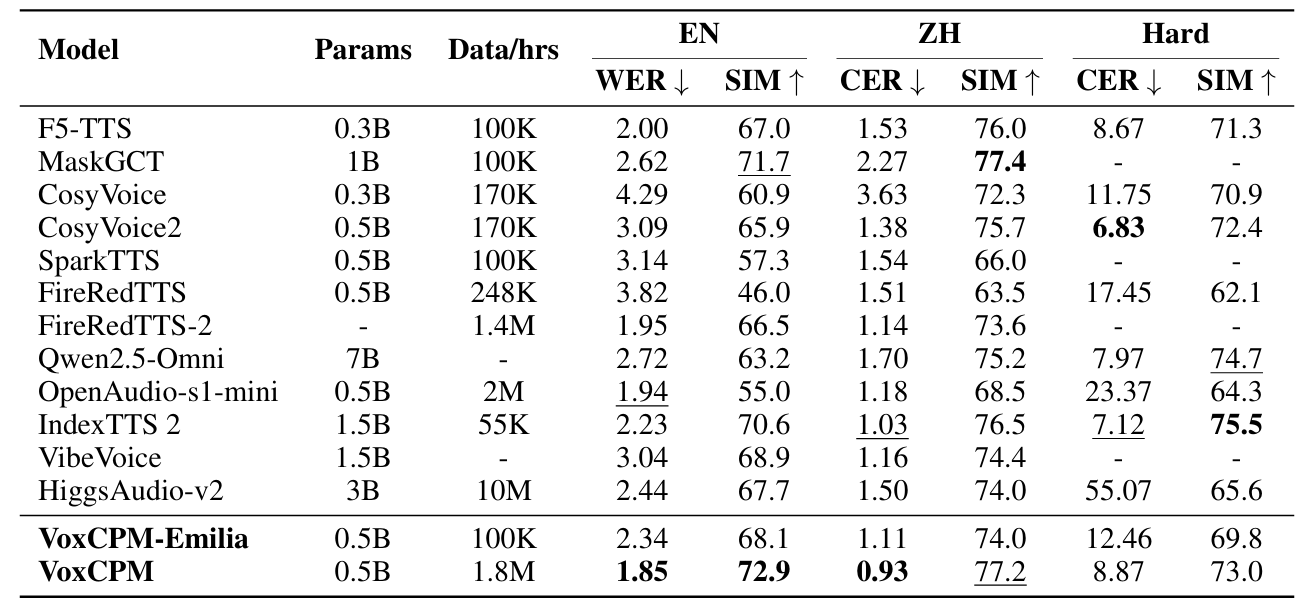
- CV3 benchmark에 대해서도 우수한 성능을 보임

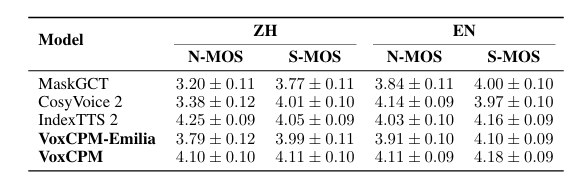
- MOS 측면에서도 높은 성능을 달성함
- Ablation Study
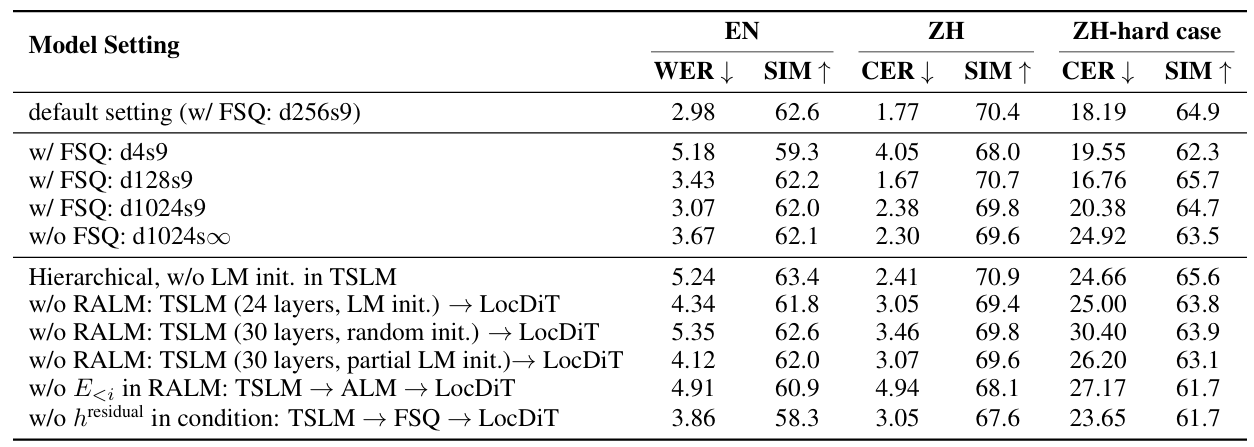
- 각 component는 성능 향상에 유효함
반응형
'Paper > Language Model' 카테고리의 다른 글
댓글