
티스토리 뷰
Paper/Representation
[Paper 리뷰] UniWav: Towards Unified Pre-Training for Speech Representation Learning and Generation
feVeRin 2025. 6. 14. 08:08반응형
UniWav: Towards Unified Pre-Training for Speech Representation Learning and Generation
- Pre-training과 representation learning은 서로 다른 foundation model을 사용함
- UniWav
- Pre-training, representation learning을 위한 unified encoder-decoder framework
- Representation encoder와 generative decoder를 jointly learning
- 논문 (ICLR 2025) : Paper Link
1. Introduction
- Speech representation은 specific task를 excelling 하는 데 사용됨
- 특히 HuBERT, Wav2Vec 2.0과 같은 pre-training method는 unlabeled speech로부터 self-supervised learning을 통해 speech representation을 학습함
- 해당 representation model은 masked audio에서 추출된 output과 unmasked audio에서 추출된 output을 matching 하는 masked audio modeling을 주로 활용함
- Masked audio modeling을 통해 얻어진 representation은 phonetic, semantic content를 주로 capture 하므로 speaker timbre, acoustic environment와 같은 acoustic information을 반영하기 어려움
- 결과적으로 self-supervised representation은 classification, recognition task에서만 제한적으로 활용됨
- 한편으로 SpeechFlow와 같이 generative model에 masked audio modeling을 적용하여 minimal supervision으로 downstream task에 transfer 할 수도 있음
- BUT, pre-training과 generative method는 전체적으로 유사한 masked audio modeling을 활용함에도 불구하고, 여전히 개별적으로 설계되고 training 됨 - 이때 representation learning, generation에 대한 unified pre-training framework를 구성하면 training overhead를 줄이고 discriminative, generative downstream application을 모두 지원할 수 있음
-> 그래서 discriminative, generative task에 대한 unified pre-training framework인 UniWav를 제안
- UniWav
- Representation encoder와 learned representation으로 condition 된 flow matching decoder를 integrate 한 encoder-decoder framework
- Encoder, decoder를 end-to-end manner로 jointly scratch training 함으로써 speech discriminative, generation task를 모두 지원
< Overall of UniWav >
- Speech representation learning, generation을 위한 unified pre-training framework
- 결과적으로 기존보다 뛰어난 성능을 달성
2. Method
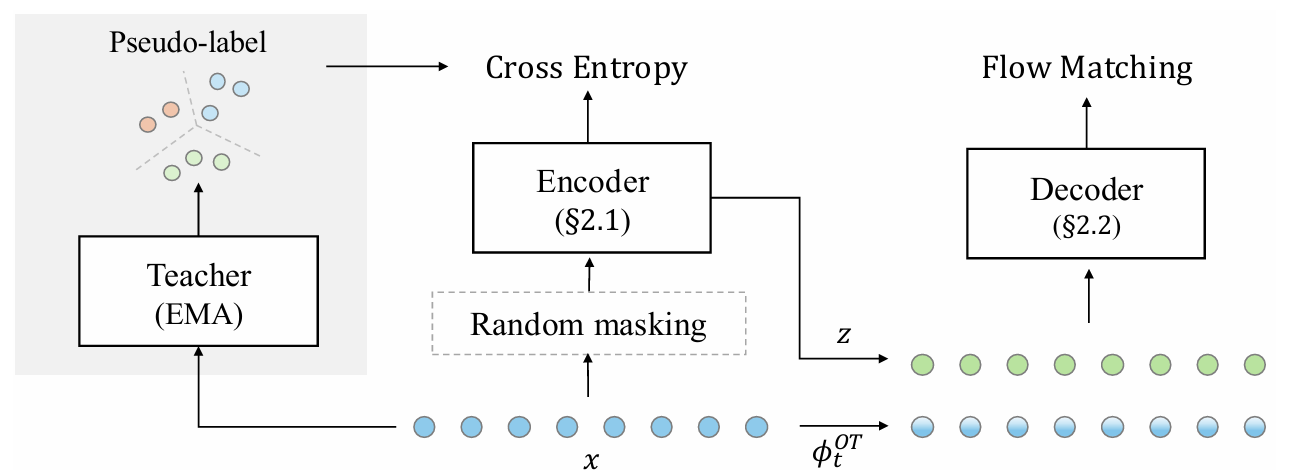
- UniWav는 representation learning과 generative task를 unify 하는 encoder-decoder framework에 해당함
- Input으로는 EnCodec과 같은 speech의 surface feature를 사용함
- 이후 masked audio modeling을 통해 input에 대한 latent representation encoding과 speech generation을 jointly learning 함
- Representation Encoder
- Self-supervised learning은 unlabeled data의 input 자체에서 learning target을 derive 하여 representation을 학습함
- 논문에서는 self-supervised learning을 위해 self-distillation과 online clustering을 채택함
- $\mathbf{x}_{i}\in\mathbb{R}^{d}$를 speech의 input surface feature frame, $x=(\mathbf{x}_{1},\mathbf{x}_{2},...,\mathbf{x}_{L})$을 input audio frame sequence라고 하자
- 그러면 frame의 subset을 randomly mask 한 $M$을 Transformer encoder에 전달하여 output latent embedding $z=(\mathbf{z}_{1},\mathbf{z}_{2},...,\mathbf{z}_{L})$을 얻을 수 있음
- $\mathbf{z}_{i}\in\mathbb{R}^{d}$ - 이때 encoder는 (Eq. 1)을 maximize 하여 teacher가 제공한 pseudo-label $y_{i}$를 predict 함:
(Eq. 1) $\frac{1}{|M|}\sum_{i:\mathbf{x}_{i}\in M}\log p_{\phi}(y_{i}|\mathbf{z}_{i})$
- $\phi$ : pseudo-label prediction head - Pseudo-label을 derive 하는 teacher model은 encoder의 Exponential Moving Average (EMA) $\theta_{teacher}\leftarrow \gamma_{teacher}\theta_{teacher}+(1-\gamma_{teacher})\theta_{encoder}$와 같음
- $\gamma_{teacher}$ : decay factor
- 그러면 frame의 subset을 randomly mask 한 $M$을 Transformer encoder에 전달하여 output latent embedding $z=(\mathbf{z}_{1},\mathbf{z}_{2},...,\mathbf{z}_{L})$을 얻을 수 있음
- 이때 encoder는 masked audio를 input으로 사용하고 teacher model은 masking이 없는 complete audio를 input으로 사용하여 input frame $\mathbf{x}_{i}$에 대해 pseudo-label을 derive 함:
(Eq. 2) $y_{i}=\arg\min_{v\in V}|| \tilde{\mathbf{z}}_{i}-\mathbf{e}_{v}||_{2} $
- $\tilde{\mathbf{z}}_{i}$ : teacher model output, $\mathbf{e}_{v}$ : size $V$ codebook의 codeword - 모든 codeword는 same pseudo-label을 share 하는 teacher output embedding의 EMA를 통해 update 됨:
(Eq. 3) $\mathbf{s}_{v}\leftarrow \gamma_{code}\mathbf{s}_{v}+(1-\gamma_{code})\sum_{i:y_{i}=v}\tilde{\mathbf{z}}_{i}$
$\,\,\,\,\,\,\,\,\,\,\,\,\,\,\,\,\,n_{v}\leftarrow\gamma_{code}n_{v} +(1-\gamma_{code})\sum_{i:y_{i}=v}1$
$\,\,\,\,\,\,\,\,\,\,\,\,\,\,\,\,\,\mathbf{e}_{v}\leftarrow\frac{\mathbf{s}_{v}}{n_{v}}$
- $\gamma_{code}$ : decay factor, $\mathbf{s}_{v}\in\mathbb{R}^{d}$ : cluster sum으로써, randomly initialize 됨
- $n_{v}$ : cluster size로써 $1$로 initialize 됨 - 논문은 각 layer에 대해 (Eq. 1-3)을 repeating 하여 teacher model의 top-$K$ layer에 대한 pseudo-label을 고려하고, 이때 encoder의 complete loss function은:
(Eq. 4) $\mathcal{L}_{encoder}=-\frac{1}{|K||M|}\sum_{i:\mathbf{x}_{i}\in M}\sum_{k\in K}\log p_{\phi_{k}}(y_{i}^{(k)}|\mathbf{z}_{i})$
- $K$ : 각각 independent codebook을 가지는 teacher model layer의 index set
- Prediction은 target layer $k$에 관계없이 $\mathbf{z}_{i}$를 사용하여 final layer에서 수행됨
- Flow Matching Decoder
- 논문은 decoder를 training 하기 위해 flow matching을 채택함
- Flow matching은 unknow data distribution $q(x)$로부터 sample $x_{1}$을 생성하는 것으로써, prior distribution $p_{0}$와 target distribution $p_{1}\approx q$ 간의 path를 따라 $x$의 flow를 predict 함
- 여기서 flow는 Ordinary Differential Equation (ODE)를 통해 정의됨:
(Eq. 5) $\frac{d}{dt}\phi_{t}(x)=v_{t}(\phi_{t}(x));\,\,\,\phi_{0}(x)=x$
- $v_{t}:[0,1]\times \mathbb{R}^{d}\rightarrow \mathbb{R}^{d}$ : time-dependent vector field - Variable change formula를 통해 path를 따라 timestep $t$에서 distribution $p_{t}$를 generate 할 수 있음
- 이를 기반으로 (Eq. 5)를 $t=0$에서 $t=1$까지 iterative solve 하여 $p_{1}$을 sampling 함
- 여기서 flow는 Ordinary Differential Equation (ODE)를 통해 정의됨:
- 해당 framework 하에서 decoder는 path를 생성하는 target vector field $u_{t}$와 match 하는 time-dependent vector field $v_{t}(x;\theta_{decoder})$를 predict 하는 것을 목표로 함
- 이때 decoder output을 $u_{t}$에 regress 하는 naive flow matching은 target vector field $u_{t}$가 generally unknown이므로 intractable 함
- 대신 real data sample $x_{1}$을 사용하여 tractable $p_{t},u_{t}$를 가진 $x$의 conditional flow를 구성할 수 있음 - 먼저 Optimal Transport (OT) conditional path는 mean $\mu_{t}(x)=tx_{1}$, standard deviation $\sigma_{t}(x)=1-(1-\sigma_{\min})t$가 time에 따라 linearly change 한다고 가정함
- $\sigma_{\min}$은 $p_{1}(x|x_{1})$이 $x_{1}$ 주변에 center 되도록 sufficiently small 함 - 그러면 OT conditional flow는:
(Eq. 6) $\phi_{t}^{OT}(x)=(1-(1-\sigma_{\min})t)x_{0}+tx_{1}$ - Tractable $p_{t}(x|x_{1})=\mathcal{N}(x|\mu_{t}(x_{1}),\sigma_{t}(x_{1})^{2}I)$와 $u_{t}(x|x_{1})=\frac{(x_{1}-(1-\sigma_{\min})x)}{(1-(1-\sigma_{\min})t)}$로부터 derive 되는 Conditional Flow Matching (CFM) objective는:
(Eq. 7) $\mathbb{E}_{t,q(x_{1}),p_{0}(x_{0})}\left|\left| v_{t}\left(\phi_{t}^{OT}(x_{0});\theta_{decoder}\right)- \left(x_{1}-(1-\sigma_{\min})x_{0}\right)\right|\right|^{2}$
- $p_{0}$ : standard Normal distribution, $t$ : $[0,1]$에서 uniformly sample 됨
- CFM objective와 naive flow matching은 model에 대해 identical gradient를 share 하므로 (Eq. 5)는 trained CFM을 통해 solve 될 수 있음
- 이때 decoder output을 $u_{t}$에 regress 하는 naive flow matching은 target vector field $u_{t}$가 generally unknown이므로 intractable 함
- 추가적으로 논문은 decoder를 encoder layer feature $z$의 weighted sum으로 condition 하여 decoder에 대한 complete loss function을 얻음:
(Eq. 8) $\mathcal{L}_{decoder}=\mathbb{E}_{t,q(x_{1}),p_{0}(x_{0})}\left|\left| v_{t}\left(\phi_{t}^{OT}(x_{0}),z;\theta_{decoder}\right)- \left(x_{1}-(1-\sigma_{\min})x_{0}\right)\right|\right|^{2}$ - Representation encoder와 마찬가지로 generative decoder는 $d$-dimensional latent를 가지는 Transformer encoder로 구성되고, 이때 decoder input은:
(Eq. 9) $W_{0}v_{t}\left(\phi_{t}^{OT}(x_{0})\right)+z,\,\,\, \text{where}\,\, z=\sum_{i}W_{i}z^{(i)}$
- $W_{0}\in\mathbb{R}^{d_{x}\times d}$ : noisy data projection layer, $W_{i}\in\mathbb{R}^{d\times d}$ : encoder $i$-th layer의 representation $z^{(i)}$에 대한 linear projection layer
- 즉, decoder는 noise-injected audio feature $x$와 모든 encoder layer의 representation에 대한 learnable combination $z$를 input으로 사용함
- Flow matching은 unknow data distribution $q(x)$로부터 sample $x_{1}$을 생성하는 것으로써, prior distribution $p_{0}$와 target distribution $p_{1}\approx q$ 간의 path를 따라 $x$의 flow를 predict 함
- UniWav Framework
- UniWav는 end-to-end manner로 training 됨
- 이때 overall objective는 encoder obejctive (Eq. 4), decoder objective (Eq. 8)을 combine 하여 얻어짐:
(Eq. 10) $\mathcal{L}_{encoder}+\lambda\mathcal{L}_{decoder}$
- $\lambda=0.25$ : weighting scalar - HuBERT, WavLM 등은 teacher model로부터 representation을 iteratively learning 하는 반면, UniWav는 self-distillation과 online clustering을 사용하여 encoder, decoder를 scratch training 함
- Pre-training 이후 encoder는 representation을 추출하는 stand-alone module로 사용할 수 있음
- 이때 overall objective는 encoder obejctive (Eq. 4), decoder objective (Eq. 8)을 combine 하여 얻어짐:
3. Experiments
- Settings
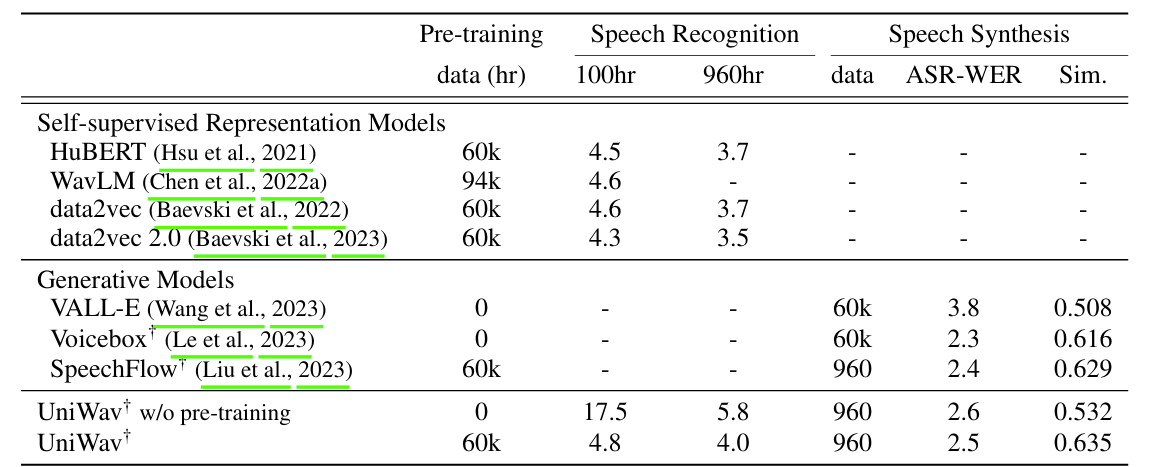
- Dataset : LibriLight
- Comparisons
- Self-Supervised Representation : HuBERT, WavLM, Data2Vec, Data2Vec 2.0
- Generative Model : SpeechFlow, VALL-E, VoiceBox
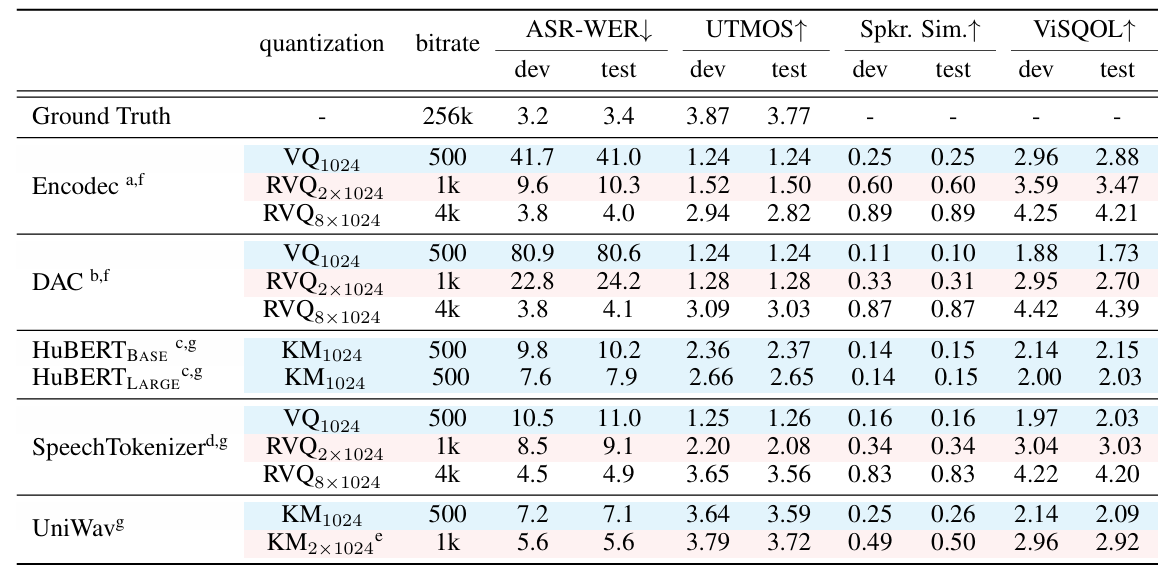
- Speech Codec : EnCodec, DAC, SpeechTokenizer
- Results
- 전체적으로 UniWav의 성능이 가장 우수함
- Speech Tokenization
- Tokenization을 위해 (Eq. 9)의 encoder representation $z$를 다음과 같이 replace 함:
(Eq. 11) $ \bar{z}=W_{i}\underset{\text{semantic quantization}}{\underbrace{\arg\min_{q\in Q_{i}}\left|\left| z^{(i)}-q\right|\right|_{2}}}+\underset{\text{residual quantization (optional)}}{\underbrace{\arg\min_{q\in Q_{residual}}\left|\left| \sum_{j\neq i} W_{j}z^{(j)}-q\right|\right|_{2} }}$ - Speech tokenization 측면에서도 UniWav의 성능이 가장 뛰어남
- Tokenization을 위해 (Eq. 9)의 encoder representation $z$를 다음과 같이 replace 함:
- Scaling Encoder and Decoder
- Shallow encoder로 speech recognition을 수행하면 WER이 저하됨
- Speech generation의 경우 shallow encoder를 사용할 때 encoder depth가 큰 영향을 미침

- Mutual Information Between Representation and Labels
- Latter layer에서 UniWav는 HuBERT에 비해 phone에 대한 Mutual Information (MI)가 낮음
- Speaker label에 대한 MI는 대부분의 layer에서 UniWav가 더 높게 나타남

반응형
'Paper > Representation' 카테고리의 다른 글
댓글