
티스토리 뷰
Paper/Neural Codec
[Paper 리뷰] ContextCodec: Content-Focused Context Guidance for Ultra-Low Bitrate Speech Coding
feVeRin 2026. 10. 29.반응형
ContextCodec: Content-Focused Context Guidance for Ultra-Low Bitrate Speech Coding
- Neural codec은 ultra-low bitrate에서는 preceptual quality, intelligibility를 preserve 하기 어려움
- ContextCodec
- Acoustic detail, content-focused context를 decouple하는 dual-branch encoder를 통해 explicit guide를 제공
- Lightweight autoregressive latent refinement module을 도입해 quality-intelligibility trade-off를 개선
- 논문 (INTERSPEECH 2026) : Paper Link
1. Introduction
- Neural speech codec은 continuous speech signal을 compact discrete representation으로 convert함
- 대표적으로 SoundStream과 같은 acoustic codec이나 X-Codec과 같은 hybrid codec을 활용하여 speech coding을 수행할 수 있음
- BUT, ultra-low bitrate에서 speech coding은 zero-sum bit-allocation problem이 되므로 intelligibility와 perceptual naturalness를 maintain하기 어려움
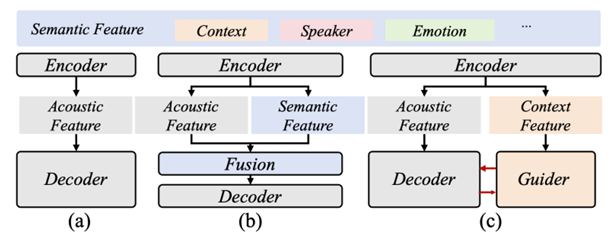
-> 그래서 ultra-low bitrate에서도 fidelity, intelligibility를 유지할 수 있는 ContextCodec을 제안
- ContextCodec
- Dual-branch encoder를 활용하여 acoustic-detail modeling과 content-focused context modeling을 decoupling하고 CLIP-style alignment를 통해 linguistically aligned context representation을 학습
- Acoustic pre-conditioning과 stage-wise context injection을 기반으로 context guidance를 제공하는 context-guided attention decoder와 reconstruction quality를 향상하는 autoregressive refinement module을 도입
< Overall of ContextCodec >
- Dual-branch architecture와 context guidance를 활용한 ultra-low bitrate neural codec
- 결과적으로 기존보다 우수한 성능을 달성
2. Method
- ContextCodec은 Finite Scalar Quantization (FSQ)를 사용하는 GAN-based quantized autoencoder framework로 구성됨
- 이때 shared encoder, decoder, discriminator는 DAC architecture를 따름
- Overall Architecture
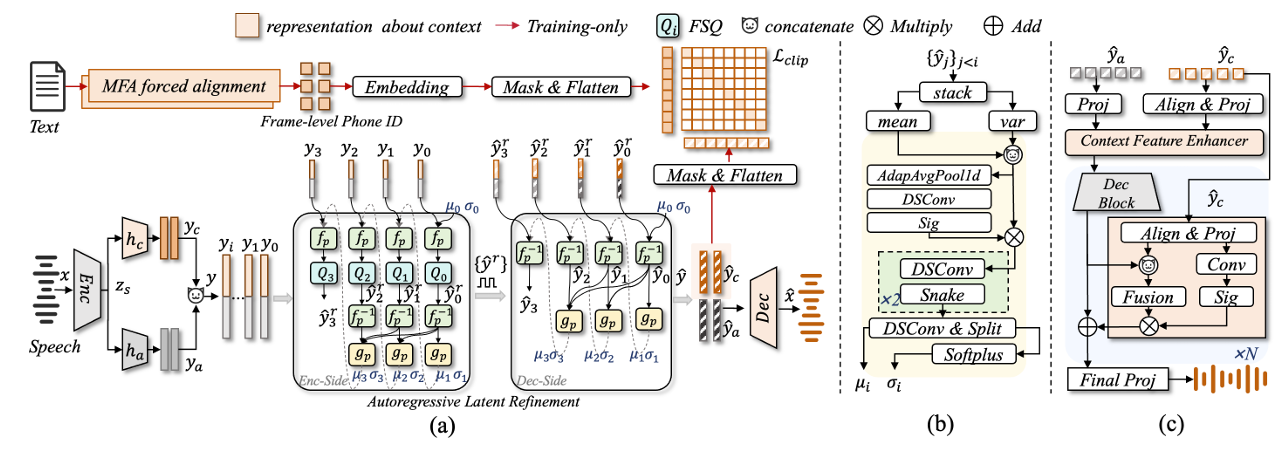
- ContextCodec은 input waveform $x$를 shared feature $z_{s}=\text{Enc}(x)$로 mapping 하고, dual-branch encoder를 적용해 acoustic stream $y_{a}\in\mathbb{R}^{B\times d_{a}\times T}$, context stream $y_{c}\in\mathbb{R}^{B\times d_{c}\times T}$를 얻음
- 이때 concatenated latent는 $y=[y_{a};y_{c}]$와 같음
- $B$ : batch size, $T$ : codec frame 수 - Training pipeline은 3-stage로 구성됨:
- Autoregressive Latent Refinement
- $y$를 interleaved phase $\{y_{i}\}_{i=0}^{P-1}$로 partition하고, phase-specific quantization을 위한 per-phase statistics를 estimate 하는 reusable predictor $g_{p}$를 사용하여 refined symbol $\hat{y}^{r}$를 얻음
- Decoder에서는 $\hat{y}^{r}$로부터 restored refined latent $\hat{y}$를 reconstruct 함 - CLIP-style Phoneme Alignment
- $\hat{y}$는 $\hat{y}_{a},\hat{y}_{c}$로 split 되고 quantized context code는 text data에서 forced-aligned phoneme에 대해 frame-level contrastive loss로 supervise 됨 - Context-Guided Attention Decoding
- Decoder는 각 decoding stage에 $\hat{y}_{c}$를 inject 하여 waveform $\hat{x}=\text{Dec}(\hat{y}_{a},\hat{y}_{c})$를 reconstruct 함
- Autoregressive Latent Refinement
- 이때 concatenated latent는 $y=[y_{a};y_{c}]$와 같음
- Autoregressive Latent Refinement
- Tight budget에서 bit를 allocate 하기 위해 decoding 전에 concatenated latent $y=[y_{a},y_{c}]$를 refine 함
- 이때 already restored phase에서 per-phase mean/scale을 sequentially predict 하고 normalized residual을 quantize 하여 causal, lightweight manner로 refined symbol $\hat{y}^{r}$과 restored $\hat{y}$를 얻음
- 이를 위해 $y$를 $P$ interleaved phase sequence $\{y_{i}\}_{i=0}^{P-1}$로 split 하고 각 $P$-frame block 내에서 phase를 $0\rightarrow P-1$과 같이 sequentially process 함
- Frame $t\equiv i \mod P$
- Encoder-Side
- Phase $i$의 restored refined result를 $\hat{y}_{i}$라고 하자
- $i=0$인 경우, phase-specific quantizer $Q_{0}$를 사용하여 $\hat{y}_{0}^{r}=Q_{0}(y_{0}), \hat{y}_{0}=\hat{y}_{0}^{r}$과 같이 directly quantize 함
- $\mu_{0}=0,\sigma_{0}=1$ - $i=1,...,P-1$ phase에서는 resuable predictor $g_{p}$를 사용하여 already restored sub-sequence로 부터 $(\mu_{i},\sigma_{i})=g_{p}(\{\hat{y}_{j}\}_{j<i})$와 같이 per-time mean/scale을 estimate 함
- $g_{p}$ module은 $\{\hat{y}_{j}\}_{j<i}$ 전반에 대한 per-time mean/standard deviation을 compute 하여 available context를 aggregate 하고
- Adaptive average pooling과 1D convolution, sigmoid로 구성된 lightweight global gate를 적용한 다음, Snake activation을 포함한 depthwise-separable 1D convolution stack을 통해 $(\mu_{i},\sigma_{i})$를 output 함
- 이후 predicted mean/scale을 remove 하여 normalized residual을 얻음:
(Eq. 1) $\epsilon_{i}=f_{p}(y_{i};\mu_{i},\sigma_{i})=(y_{i}-\mu_{i})\oslash\sigma_{i}$
- 논문은 해당 $\epsilon_{i}$를 phase-specific quantizer로 quantize 하고 다음과 같이 restore 함:
(Eq. 2) $\hat{y}^{r}_{i}=Q_{i}(\epsilon_{i}),\,\,\hat{y}_{i}=f_{p}^{-1}(\hat{y}_{i}^{r};\mu_{i},\sigma_{i})=\mu_{i}+\sigma_{i}\odot \hat{y}^{r}_{i}$
- $\oslash$ : element-wise division, $\odot$ : element-wise multiplication - $\{\hat{y}_{i}^{r}\}_{i=0}^{P-1}$을 full rate로 interleave back 하여 얻어진 refined quantized sequence $\hat{y}^{r}$은 bitstream으로 code 되어 decoder에 transmit 됨
- Decoder-Side
- Decoder는 received stream을 parse 하여 discrete symbol $\hat{y}^{r}$을 recover 한 다음, 같은 phase order $0\rightarrow P-1$을 repeat 하여 restored refined latent $\hat{y}$를 reconstruct 함
- $i=0$인 경우, $\hat{y}_{0}=\hat{y}_{0}^{r}$로 설정
- $i\geq 1$인 경우, already restored phase로부터 $(\mu_{i},\sigma_{i})=g_{p}(\{\hat{y}_{j}\}_{j<i})$를 recompute 한 뒤 $\hat{y}_{i}=f_{p}^{-1}(\hat{y}^{r}_{i};\mu_{i},\sigma_{i})$를 적용함
- 최종적으로는 $\{\hat{y}_{i}\}_{i=0}^{P-1}$을 full rate로 interleave 하여 $\hat{y}$를 구한 다음, waveform decoder로 전달함
- Decoder는 received stream을 parse 하여 discrete symbol $\hat{y}^{r}$을 recover 한 다음, 같은 phase order $0\rightarrow P-1$을 repeat 하여 restored refined latent $\hat{y}$를 reconstruct 함
- CLIP-style Phoneme Alignment
- 논문은 codec frame rate에서 codec context feature를 paired phoneme sequence와 directly matching 하는 frame-level CLIP-style alignment objective를 도입함
- 해당 objective는 content-focused, frame-consistent context representation을 보장하고 context branch에서 speaker-related, paralinguistic leakage를 reduce 하는 것을 목표로 함
- 이를 위해 논문은 Montreal Forced Aligner (MFA)로 frame-level phoneme ID를 얻은 다음, embedding table을 통해 learnable vector로 mapping 함
- $\hat{y}_{c}\in\mathbb{R}^{B\times d_{c}\times T}$를 $\hat{y}$의 frame-wise quantized context representation, $q\in\mathbb{N}^{B\times T}$를 aligned phoneme index라고 하자
- 먼저 embedding table은 $q$를 $e\in\mathbb{R}^{B\times T\times d_{c}}$로 mapping 함
- 여기서 valid frame을 select 하기 위해 binary mask $m\in\{0,1\}^{B\times T}$를 정의한 다음, Mask & Flatten을 수행하여 invalid frame은 drop 하고 valid frame pair만 $N$ sample로 flattening 함
- 그러면 CLIP-style contrastive objective는:
(Eq. 3) $\ell_{ij}=\frac{\text{sim}(\tilde{y}_{c,i},\tilde{e}_{j})}{\tau},\,\,i,j=1,...,N$
(Eq. 4) $\mathcal{L}_{clip}=\frac{1}{2}\left(\text{CE}(\ell,t)+\text{CE}(\ell^{\top},t)\right),\,\,t_{i}=i$
- $\text{sim}(\cdot)$ : cosine similarity, $\tau$ : temperature, $\tilde{y}_{c},\tilde{e}$는 $\ell_{2}$-normalize 됨
- Sample $i$의 positive pair는 aligned $\texttt{(utterance, frame)}$ pair $(\tilde{y}_{c,i},\tilde{e}_{i})$이고, negative pair는 mini-batch의 나머지 valid frame에 해당함
- Context-Guided Attention Decoder
- Context-guided attention decoder $\text{Dec}(\cdot)$은 quantized context representation $\hat{y}_{c}$를 waveform reconstruction에 inject 하여 context branch가 generation을 guide 할 수 있도록 함
- Restored refined latent $\hat{y}=f_{p}^{-1}(\hat{y}^{r})$이 주어지면 channel dimension을 따라 acoustic stream $\hat{y}_{a}$, context stream $\hat{y}_{c}$로 split 함
- Upsampling 전, lightweight context feature enhancer에서 $\hat{y}_{c}$를 이용해 $\hat{y}_{a}$를 두 가지 complementary pathway로 modulate 함
- Global pathway는 channel-wise gate를 생성하고, local pathway는 time-varying residual을 predict 함 - 이후 gated, residual-modulated feature를 concatenate 하고 fusion network로 fuse 하여 context-conditioned acoustic feature를 얻음
- Upsampling 전, lightweight context feature enhancer에서 $\hat{y}_{c}$를 이용해 $\hat{y}_{a}$를 두 가지 complementary pathway로 modulate 함
- 논문은 transposed-convolution decoder block과 Snake activation을 가진 residual 1D convolution unit을 사용해 acoustic stream을 progressively upsample 함
- 각 decoding stage에서 context stream은 Align & Proj를 따라 lienar interpolation으로 current temporal resolution에 align 되고 pointwise convolution을 통해 acoustic channel size로 project 됨
- Projected context feature는 sigmoide gate $\text{Sig}$를 통과하고, stage-wise fusion은 acoustic, projected context feature를 concatenate 한 다음 kernel-3 convolution, Snake, pointwise convolution을 통과함
- Final waveform은 Snake, kernel-7 1D convolution, $\text{tanh}$ output layer를 통해 얻어짐
- Restored refined latent $\hat{y}=f_{p}^{-1}(\hat{y}^{r})$이 주어지면 channel dimension을 따라 acoustic stream $\hat{y}_{a}$, context stream $\hat{y}_{c}$로 split 함
- Training Objective
- 논문은 reconstruction, adversarial, cross-modal alignment objective를 jointly optimize 함
- 이때 generator loss는:
(Eq. 5) $\mathcal{L}_{G}=\lambda_{m}\mathcal{L}_{m}+\lambda_{adv}\mathcal{L}_{adv}^{G}+\lambda_{fm}\mathcal{L}_{fm}+\lambda_{clip}\mathcal{L}_{clip}$
- $\mathcal{L}_{m}$ : multi-scale mel loss, $\mathcal{L}_{adv}^{G}$ GAN generator loss, $\mathcal{L}_{fm}$ : feature matching loss, $\mathcal{L}_{clip}$ : symmetric InfoNCE loss - Discriminator는 $\mathcal{L}_{D}=\mathcal{L}_{adv}^{D}$로 optimize 됨
- 이때 generator loss는:
3. Experiments
- Settings
- Dataset : LibriTTS, AISHELL3
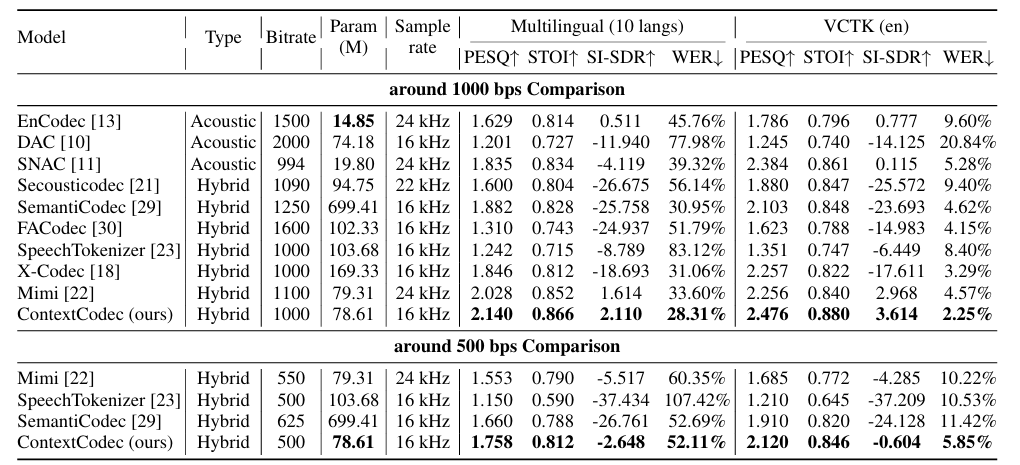
- Comparisons : EnCodec, DAC, SemantiCodec, FACodec, SpeechTokenizer, X-Codec 등
- Results
- 전체적으로 ContextCodec의 성능이 가장 우수함
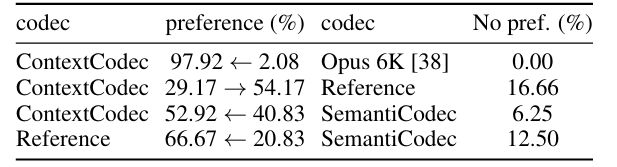
- Pairwise preference test에서도 ContextCodec이 가장 선호됨
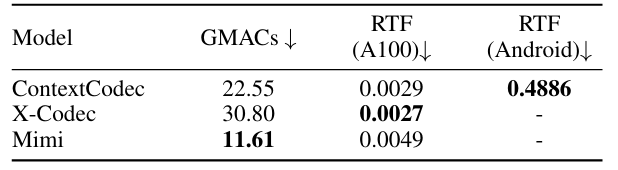
- ContextCodec은 practical deployment에도 유리함
- Ablation Study
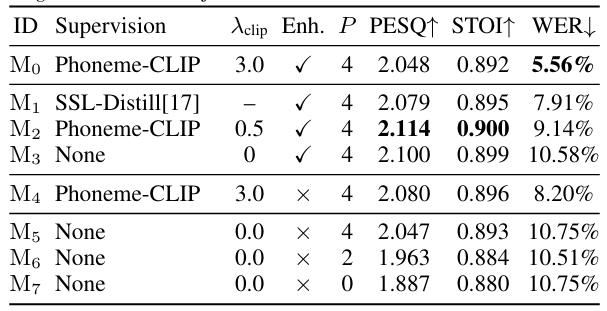
- 각 component는 성능 향상에 유효함
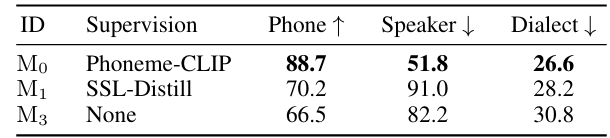
- Phoneme-CLIP을 사용하면 predictablity를 향상할 수 있음
반응형
'Paper > Neural Codec' 카테고리의 다른 글
댓글