

티스토리 뷰
Paper/Representation
[Paper 리뷰] POWSM: A Phonetic Open Whisper-Style Speech Foundation Model
feVeRin 2026. 9. 1. 12:52반응형
POWSM: A Phonetic Open Whisper-Style Speech Foundation Model
- Automatic Speech Recognition, Phoneme Recognition, Grapheme-to-Phoneme, Phoneme-to-Grapheme conversion은 각각의 task-specific architecture에 의존함
- POWSM
- Multiple phone-related task를 jointly perform 하는 unified framework
- Audio, text, phone 간의 seamless conversion을 지원
- 논문 (ACL 2026) : Paper Link
1. Introduction
- Phone은 모든 language에 대해 International Phonetic Alphabet (IPA)를 통해 represent 될 수 있음
- 특히 Automatic Speech Recognition (ASR), Phone Recognition (PR), Grapheme-to-Phoneme (G2P), Phoneme-to-Grapheme (P2G) 등의 task를 수행하기 위해서는 shared phonetic representation이 필요함
- BUT, spoken language processing에서 해당 task는 독립적으로 수행됨
- 각 system은 specific input-output mapping에 optimize되어 있어 다른 phonetic task로 확장하기 어려움
-> 그래서 multiple phone-related task를 처리할 수 있는 unified model인 POWSM을 제안
- POWSM
- ASR dataset을 task-specific format으로 reformulate하여 model이 audio, phoneme, grapheme representation 간의 consistent mapping을 학습하도록 지원
- Whisper와 같은 attention-based encoder-decoder architecture를 기반으로 large-scale foundation model을 구성
< Overall of POWSM >
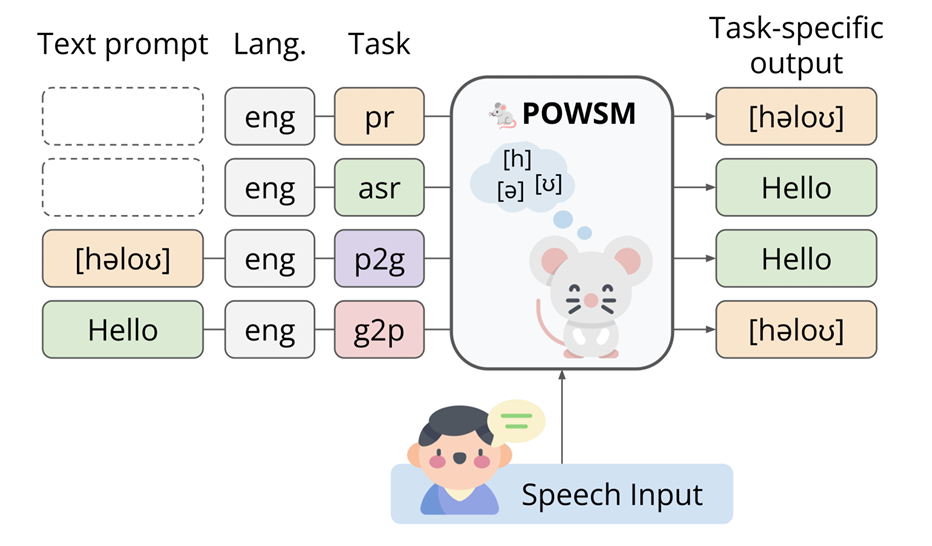
- PR, ASR, Audio-guided G2P, Auido-guided P2G task를 모두 수행할 수 있는 unified phonetic foundation model
- 결과적으로 기존보다 우수한 성능을 달성
2. Method
- Data Preparation
- 논문은 orthographic, phonemic transcription이 pair 된 IPAPack++ dataset을 사용함
- G2P-generated transcription은 manually inspect/clean 되고 300 phone 이상의 utterance는 filter out 됨
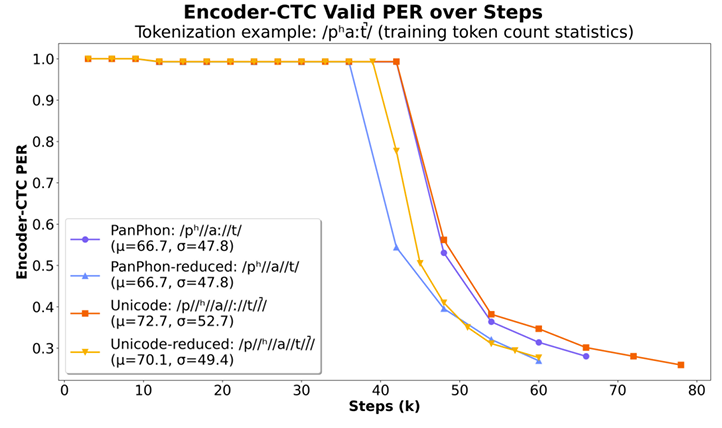
- IPA sequence는 Unicode NFD로 normalize 되고 English G2P sequence는 voice-onset time issue를 fix 하기 위해 rule-base로 correct 됨 - IPA token이 grapheme과 confuse 되지 않도록, sequence는 PanPhon phone entry를 greedy trie search를 통해 diacritic/modifier가 포함된 token으로 split 되고 slash로 enclose 됨
- G2P-generated transcription은 manually inspect/clean 되고 300 phone 이상의 utterance는 filter out 됨
- Multitask Data Format
- POWSM은 PR, ASR, Audio-guided G2P, P2G task에 대해 training 됨
- 각 utterance는 task 마다 한 번씩 사용되고, text prompt, language token, task token, target output의 task-specific format으로 구성됨
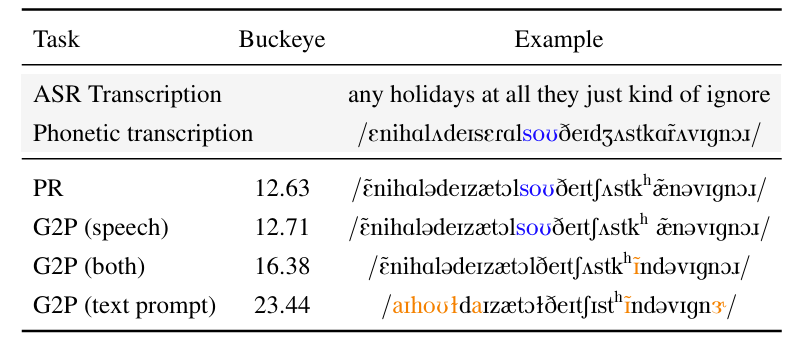
- PR, ASR의 경우 text prompt를 blank ($\texttt{<na>}$)로 두고, G2P, P2G의 경우 grapheme과 phone을 prompt로 제공함
- e.g.) Utterance $\texttt{Who is that}$의 target output은 $\texttt{"<eng><g2p><notimestamps>}\texttt{/h//u/}\texttt{/ɪ//z/}\texttt{/ð//\ae//t/"}$
- Training Details
- POWSM은 attention-based encoder-decoder (AED) architecture를 채택함
- 특히 Whisper의 general encoder-deocoder structure와 일치하는 E-Branchformer encoder, Transformer decoder 기반의 OWSM v3.1 architecture를 따름
- Model은 ESPnet을 통해 from scratch로 training 되고 hybrid CTC/attention loss를 사용함:
(Eq. 1) $\mathcal{L}=\alpha_{ctc}\mathcal{L}_{ctc}+(1-\alpha_{ctc})\mathcal{L}_{attention}$
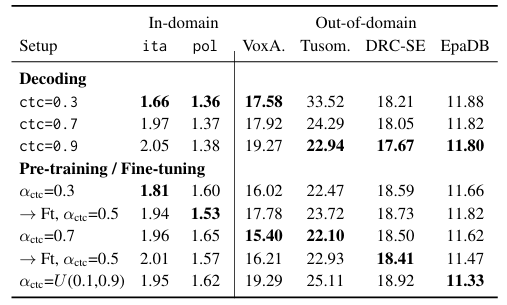
- $\alpha_{ctc}=0.3$ - Encoder는 40ms stride size를 가지고 training 시에는 256 batch size를 사용함
- Speech input은 16kHz이고 20s로 padding 됨 - 추가적으로 convergence를 accelerate 하기 위해, encoder output에서 break와 length diacritics를 strip 함
- Model은 ESPnet을 통해 from scratch로 training 되고 hybrid CTC/attention loss를 사용함:
- Decoder는 text prompt로 condition 된 autoregressive language model로써, cross-attention을 통해 encoder output에 attend 함
- 특히 Whisper의 general encoder-deocoder structure와 일치하는 E-Branchformer encoder, Transformer decoder 기반의 OWSM v3.1 architecture를 따름
3. Experiments
- Settings
- Dataset : IPAPack++
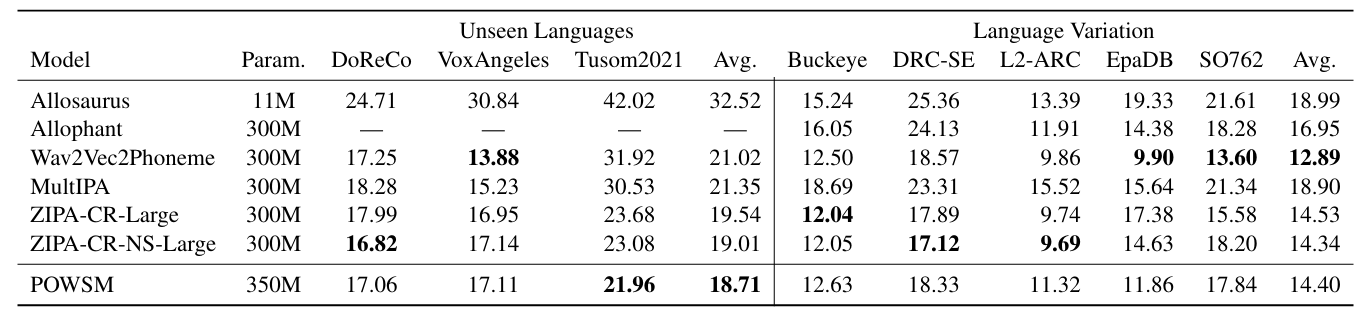
- Comparisons : Allosaurus, Allophant, Wav2Vec2Phoneme, MultIPA, ZIPA-CR
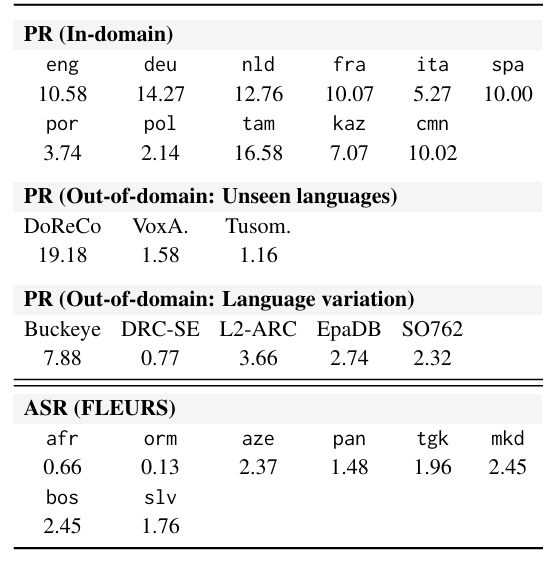
- Results
- 전체적으로 POWSM의 성능이 가장 뛰어남
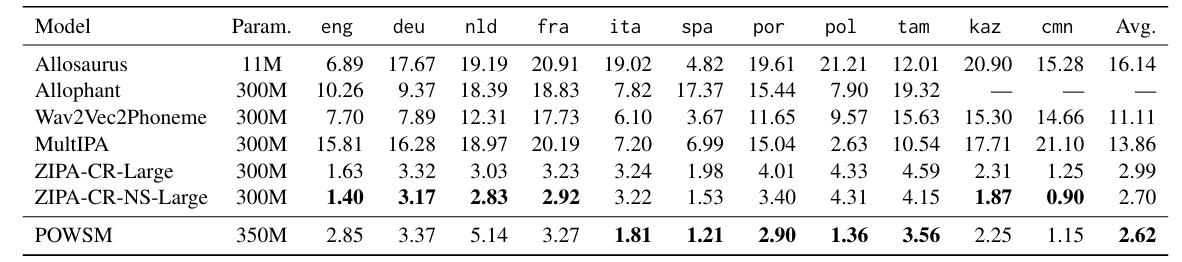
- Low-resource language에 대해서도 우수한 성능을 보임
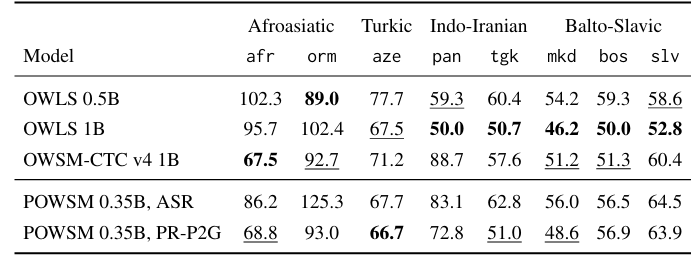
- Out-of-Domain data에 대해서도 robust 한 성능을 보임
- Analysis
- Suprasegmental distinction을 collapse 하면 CTC에서 confusion을 줄일 수 있음
- CTC decoding weight가 커지면 in-domain performance는 저하되는 대신 out-of-domain performance가 향상됨
- Speech, text prompt를 모두 사용하면 standardized pronunciation이 나타남
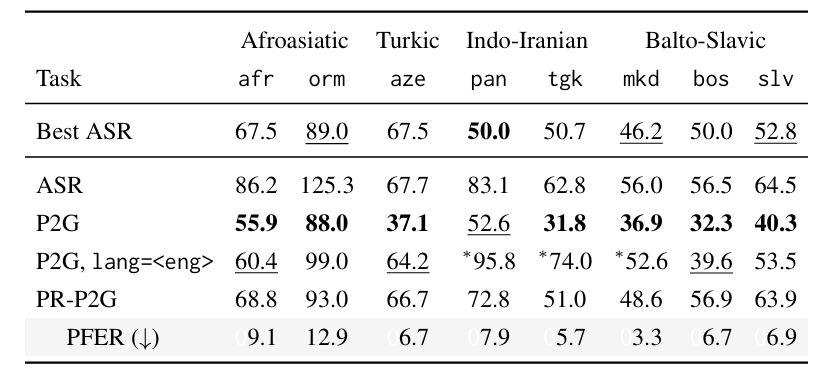
- Audio-P2G는 phone context를 활용하여 ASR 이상의 결과를 제공함
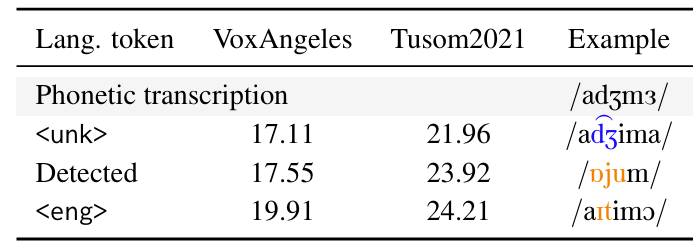
- Detected language token을 assign 하면 더 나은 성능을 달성할 수 있음
반응형
'Paper > Representation' 카테고리의 다른 글
댓글