
티스토리 뷰
Paper/Representation
[Paper 리뷰] CLAP: Learning Audio Concepts from Natural Language Supervision
feVeRin 2025. 7. 30. 17:00반응형
CLAP: Learning Audio Concepts from Natural Language Supervision
- Restricted supervision 하에서 training 된 audio model은 flexibility의 한계가 있음
- CLAP
- Natural language supervision을 통해 audio concept을 학습
- 2개의 encoder와 contrastive learning을 활용하여 audio, text description을 joint multimodal space로 modeling
- 논문 (ICASSP 2023) : Paper Link
1. Introduction
- 대부분의 audio model은 specific task의 pre-defined category와 audio recording에 대해서만 training 되므로 restricted supervision으로 인한 flexibility의 문제가 있음
- 한편으로 Wav2Vec 2.0, WavLM과 같은 Self-Supervised Learning (SSL)은 unlabeled audio를 통해 model을 pre-train 하여 limited supervision 문제를 avoid 할 수 있음
- 이때 pre-trained SSL model은 class label paradigm을 따라 downstream task에 adapt 됨 - BUT, 해당 SSL model 역시 pre-defined category만 predict 하는 static output layer를 가지므로 unseen category에 대한 zero-shot prediction을 수행하기 어려움
- 한편으로 Wav2Vec 2.0, WavLM과 같은 Self-Supervised Learning (SSL)은 unlabeled audio를 통해 model을 pre-train 하여 limited supervision 문제를 avoid 할 수 있음
-> 그래서 zero-shot audio prediction을 위해 natural language supervision을 활용한 CLAP을 제안
- CLAP
- Natural language와 audio를 connect 하기 위해 2개의 encoder와 contrastive learning을 활용하여 audio, text description을 joint multimodal space에서 modeling
- Zero-shot prediction을 통해 flexible class prediction을 지원
< Overall of CLAP >
- Contrastive learning과 natural language supervision을 활용한 audio classification model
- 결과적으로 다양한 downstream task에서 우수한 성능을 달성
2. Method
- CLAP은 audio, text pair를 input으로 하여 audio encoder와 text encoder에 전달함
- 이후 각 representation은 linear projection을 통해 joint multimodal space에 concatenate 됨
- 해당 space는 contrastive learning을 사용하여 audio, text pair의 similarity에 따라 학습됨 - Projection layer를 포함한 pre-trained encoder는 audio, text embedding을 compute 하고 zero-shot classification을 위해 사용될 수 있음
- 이후 각 representation은 linear projection을 통해 joint multimodal space에 concatenate 됨
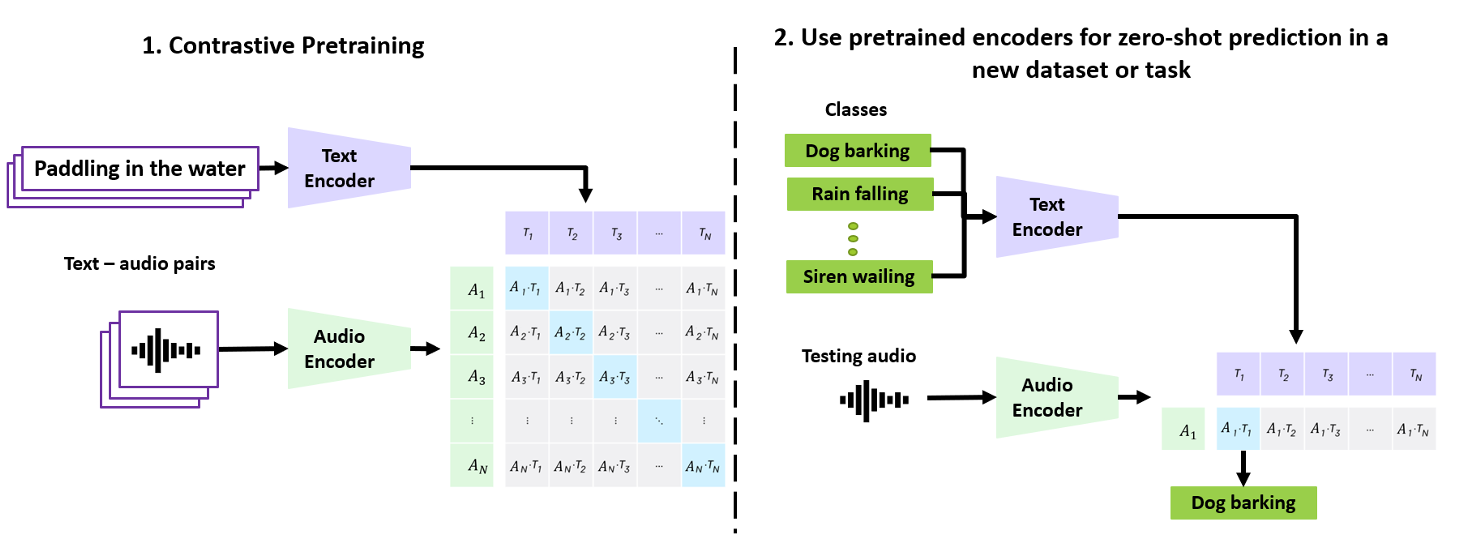
- Contrastive Language-Audio Pre-Training
- Mel bin 수 $F$, time $T$에 대해 processed audio를 $X_{a}\in\mathbb{R}^{F\times T}$, text를 $X_{t}$라고 하자
- Batch $N$에서 각 audio-text pair는 $\{X_{a},X_{t}\}_{i}$와 같이 represent 됨
- $i\in[0,N]$ - Pair에서 audio, text는 각각 audio encoder, text encoder를 통해 전달됨
- $N$ batch에 대해 audio encoder를 $f_{a}(\cdot)$, text encoder를 $f_{t}(\cdot)$이라고 하면:
(Eq. 1) $\hat{X}_{a}=f_{a}(X_{a});\,\,\,\hat{X}_{t}=f_{t}(X_{t})$
- $\hat{X}_{a}\in\mathbb{R}^{N\times V}$ : dimensionality $V$의 audio representation
- $\hat{X}_{t}\in\mathbb{R}^{N\times U}$ : dimensionality $U$의 text representation - 이때 논문은 audio, text representation $\hat{X}_{a},\hat{X}_{t}$를 learnable linear projection을 사용하여 dimension $d$의 joint multimodal space로 가져옴:
(Eq. 2) $E_{a}=L_{a}(X_{a});\,\,\,E_{t}=L_{t}(X_{t})$
- $E_{a}\in\mathbb{R}^{N\times d}, E_{t}\in\mathbb{R}^{N\times d}$
- $L_{a},L_{t}$ : 각각 audio, text에 대한 linear projection - 그러면 audio, text embedding $(E_{a},E_{t})$가 comparable 하므로 similarity를 compute 할 수 있음:
(Eq. 3) $C=\tau *(E_{t}\cdot E_{a}^{\top})$
- $\tau$ : temperature parameter
- Similarity matrix $C\in \mathbb{R}^{N\times N}$은 diagonal에서 $N$ correct pair를 가지고, off-diagonal에서 $N^{2}-N$ incorrect pair를 가짐
- $N$ batch에 대해 audio encoder를 $f_{a}(\cdot)$, text encoder를 $f_{t}(\cdot)$이라고 하면:
- 결과적으로 논문은 audio, text encoder와 linear projection을 jointly training 하기 위해, similarity matrix에 다음과 같은 symmetric cross-entropy loss $\mathcal{L}$을 사용함:
(Eq. 4) $\mathcal{L}=0.5*\left(\ell_{text}(C)+\ell_{audio}(C)\right)$
- $\ell_{k}=\frac{1}{N}\sum_{i=0}^{N}\log \text{diag} (\text{Softmax}(C))$
- Batch $N$에서 각 audio-text pair는 $\{X_{a},X_{t}\}_{i}$와 같이 represent 됨
- Zero-Shot Linear Classification
- Zero-shot classification을 위해 $C$ class label과 $N$ test audio를 가진 target dataset을 고려하자
- 먼저 pre-trained encoder와 projection layer를 통해 $N$ audio와 $C$ class에 대한 audio embedding, text embedding을 compute 함
- 이후 각 testing audio와 모든 class label 간의 cosine similarity를 compute 함
- 그러면 각 audio는 class label 수만큼의 logit을 가짐 - 최종적으로 해당 logit에 binary/multiclass classification을 위한 softmax/sigmoid를 적용하여 probability distribution을 얻음
3. Experiments
- Settings
- Dataset : FSD50K, Clotho V2, AudioCaps, MACS
- Results
- 여러 downstream task에 대해 CLAP은 뛰어난 성능을 보임
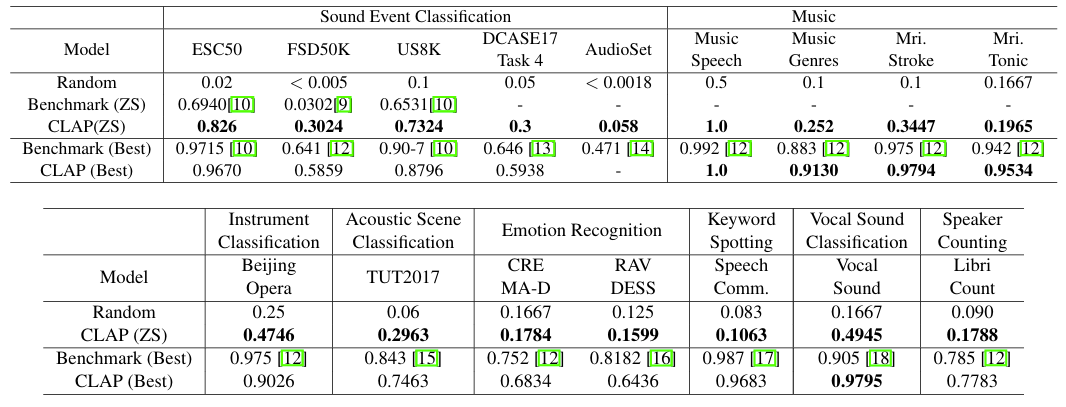
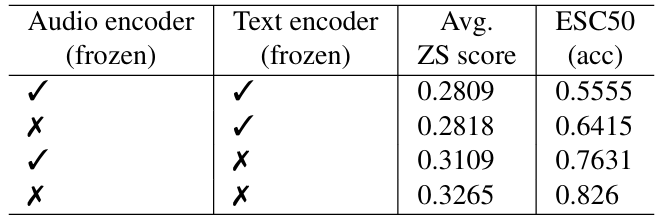
- Effect of Freezing CLAP Encoders
- Text encoder를 unfreeze 하면 audio encoder를 unfreeze 하는 것보다 더 나은 성능을 달성할 수 있음
- Changing Prompts in Zero-Shot Evaluation
- Prompt 설정에 따라 $5\%$의 성능 향상 효과를 얻을 수 있음

반응형
'Paper > Representation' 카테고리의 다른 글
댓글