
티스토리 뷰
Paper/Language Model
[Paper 리뷰] Emo-LiPO: Listwise Preference Optimization for Fine-Grained Emotion Intensity Control in LLM-based Text-to-Speech
feVeRin 2026. 6. 26. 10:37반응형
Emo-LiPO: Listwise Preference Optimization for Fine-Grained Emotion Intensity Control in LLM-based Text-to-Speech
- Large Language Model-based Text-to-Speech는 fine-grained emotion intensity control의 한계가 있음
- Emo-LiPO
- Fixed transcript 하에서 각 emotion에 대한 global intensity ordering을 modeling
- 추가적으로 multi-speaker dataset인 ESD-Plus를 구축
- 논문 (IJCAI 2026) : Paper Link
1. Introduction
- Large Language Model (LLM)-based Text-to-Speech (TTS)는 여전히 emotion intensity에 대한 fine-grained control의 한계가 존재함
- 이는 textual emotion description과 realization 간의 semantic-acoustic gap 때문
- 기존 model은 emotion intensity를 implicitly realize 하므로 high-intensity emotional prompt에서는 intensity expression이 unstable 해짐 - 이를 해결하기 위해 최근에는 preference optimization을 통해 subjective human judgement를 반영함
- BUT, 대부분의 preference-based TTS는 categorical level의 emotion을 control 하므로 emotion intensity의 ordinal structure를 explicitly modeling 하기 어려움
- 이는 textual emotion description과 realization 간의 semantic-acoustic gap 때문
-> 그래서 fine-grained emotion intensity control을 위한 Emo-LiPO를 제안
- Emo-LiPO
- Listwise Preference Optimization (LiPO)를 도입하여 emotion intensity와 prompt-conditioned speech를 explicitly align
- 특히 LLM-based TTS를 Learning-to-Rank (LTR) problem으로 formulate 하여 fine-grained modeling을 지원
< Overall of Emo-LiPO >
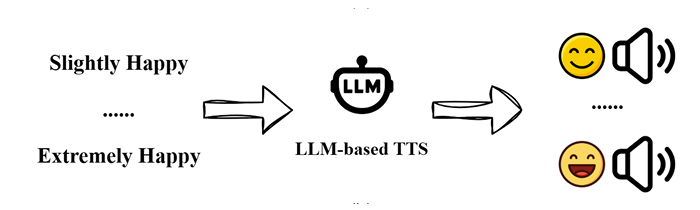
- LiPO를 활용한 emotion intensity controllable LLM-based TTS model
- 결과적으로 기존보다 우수한 성능을 달성
2. Problem Formulation
- Task Definition
- 먼저 text transcript와 emotion specification이 주어지면 LLM-based TTS model은 linguistic content, emotional attribute에 condition 된 speech를 생성함
- 이때 natural language prompt는 emotion category와 non-neutral emotion에 대한 relative intensity level을 specify 함
- $\mathcal{C}=\mathcal{C}_{emo}\cup\{neutral\}$을 emotion category라고 하자
- $\mathcal{C}_{emo}=\{happy, sad, angry\}$이고 $neutral$은 emotionally flat speech에 해당함 - 각 $c\in\mathcal{C}_{emo}$에 대해 intensity level에 대한 ordered set $\mathcal{L}=\{l_{1},l_{2},...,l_{K}\}$는 $l_{i}<l_{j}$에 대해 emotional intensity가 strictly increase 한다는 것을 의미함
- 이때 weakest level $l_{1}$은 neutral speech와 distinct 되어 emotional, non-emotional output 간의 clear bound를 preserve 함
- $\mathcal{C}=\mathcal{C}_{emo}\cup\{neutral\}$을 emotion category라고 하자
- Text transcript $t$, emotion prompt $P_{c,l}$에 대해 model input은 $x=(t, P_{c,l})$과 같이 구성됨
- $c$ : emotion category, $l$ : intensity level - 그러면 TTS model은 $S=\pi_{\theta}(x)$와 같이 speech를 생성하고, 해당 speech는 다음을 만족해야 함:
- Content Fidelity
- Speech는 transcript $t$의 linguistic content를 faithfully convey 해야 함 - Category Correctness
- Speech는 emotion $c$를 정확히 따라야 함 - Intensity Ordering
- $c\in\mathcal{C}_{emo}$에 대해, stronger level은 higher intensity level을 가져야 함
- Content Fidelity
- 이때 natural language prompt는 emotion category와 non-neutral emotion에 대한 relative intensity level을 specify 함
- Learning-to-Rank Formulation via LiPO (Emo-LiPO)
- 논문은 Listwise Preference Optimization (LiPO) framework를 활용하여 fine-grained emotion intensity control을 Learning-to-Rank (LTR) problem으로 formulate 함
- LiPO는 same text transcript로 생성된 multiple candidate로 정의된 listwise preference data로 학습되므로 emotion category correctness와 global intensity ordering을 modeling 하는데 적합함
- 특히 Emo-LiPO는 listwise formulation $\mathcal{D}_{LiPO}=\{(x=(t,P_{c,l}), y=(\mathcal{T}_{c,l},\psi_{c,l})) \}$을 사용함
- $\mathcal{T}_{c,l}$ : TTS model이 생성한 speech sample list, $\psi_{c,l}\in [0,1]^{|\mathcal{T}_{c,l}|}$ : 해당 sample과 associate 된 real-valued preference score로써 large value일수록 stronger preference를 가짐
3. Method
- Rule-based Preference Construction
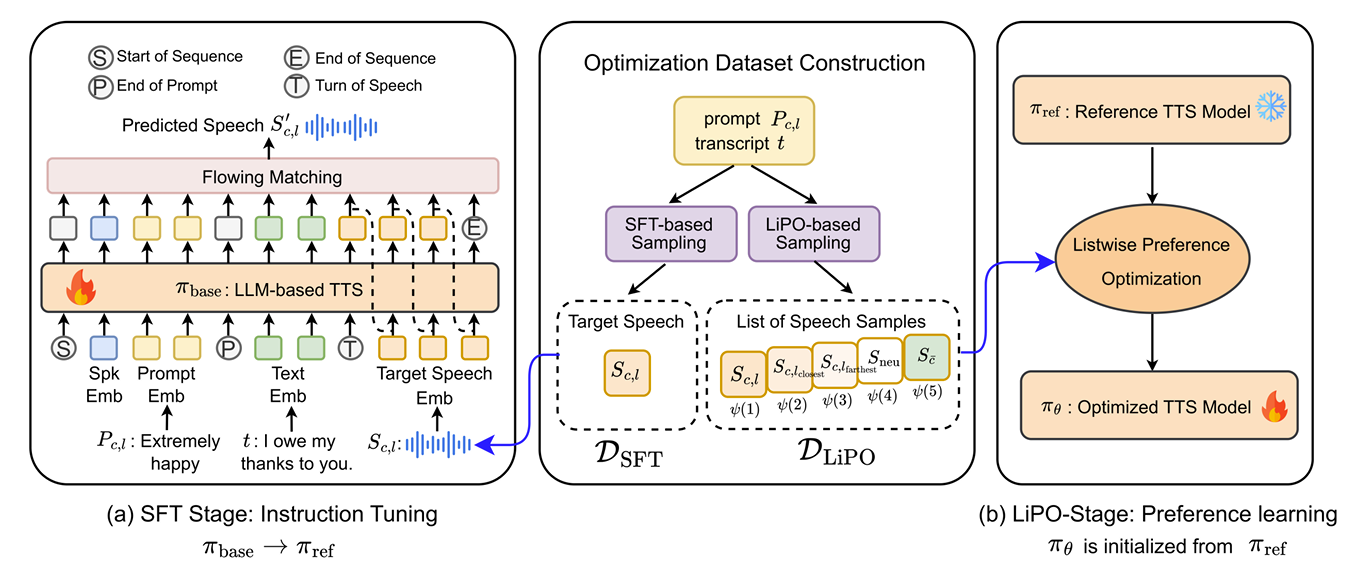
- Prompt $P_{c,l}$은 same text transcript $t$를 가진 $K+2$ speech candidate로 구성된 listwise preference set $\mathcal{T}_{c,l}$을 rule-based ranking strategy로 사용함
- 이때 list는 다음과 같이 구성됨:
- Exact emotion category $c$, intensity level $l$을 가진 target sample $S_{c,l}$
- Same category $c$의 서로 다른 intensity level $l'\in\mathcal{L}\backslash \{l\}$을 가진 $K-1$ same emotion sample
- 1개의 neutral sample
- 1개의 randomly selected non-target emotion category에 대한 negative sample
- 해당 rule-based strategy 하에서 $K-1$ same-emotion sample은 absolute intensity distance $|l'-l|$에 따라 order 되고 target intensity에 close 한 sample이 prefer 됨
- 결과적으로 preference list는:
(Eq. 1) $ \mathcal{T}_{c,l}=[S_{c,l}\succ S_{c,l_{closest}}\succ ...\succ S_{c,l_{farthest}}\succ S_{neu}\succ S_{\bar{c}}]$
- $l_{closest}, l_{farthest}$ : $l$에 따라 증가하는 intensity level을 나타냄 - Rule-based ranking에 기반하여 real-valued preference label vector $\psi_{c,l}\in[0,1]^{|\mathcal{T}_{c,l}|}$을 $\mathcal{T}_{c,l}$ 내의 speech sample에 assign 함
- 이를 위해 논문은 index-based preference scoring scheme을 채택하여, 각 sample의 preference label을 ordered list $\mathcal{T}_{c,l}$의 position에 따라 결정함
- 즉, $i$를 list 내의 sample index라고 할 때 index가 작을수록 stronger preference를 가짐 - 이때 $i$-th sample의 preference label은:
(Eq. 2) $ \psi_{c,l}(i)=1-\frac{i-1}{K+2},\,\,\, i=1,...,K+2$
- 이를 위해 논문은 index-based preference scoring scheme을 채택하여, 각 sample의 preference label을 ordered list $\mathcal{T}_{c,l}$의 position에 따라 결정함
- 이때 list는 다음과 같이 구성됨:
- Multi-Stage Optimization
- 논문은 Emo-DPO를 따라 multi-stage manner로 TTS model을 optimize 함
- LLM-based TTS model은 conditional autoregressive generation task로 formualte 되어 speech token과 speaker embedding에 대한 joint input $x=(t,P_{c,l})$을 사용함
- SFT stage에서는 paired prompt-speech dataset $\mathcal{D}_{SFT}$로 supervised fine-tuning을 수행하여 backbone TTS model $\pi_{base}$를 initialize 함:
(Eq. 3) $\mathcal{L}_{SFT}(\pi_{base})=\mathbb{E}_{(x,S)\sim \mathcal{D}_{SFT}}[-\log \pi_{base}(S|x)]$
- $\log \pi_{base}(S|x)$ : autoregressively generated speech token에 대해 token-level cross-entropy를 사용한 teacher forcing으로 compute 됨
- Resulting model은 reference TTS policy $\pi_{ref}$와 같음 - LiPO stage에서는 $\pi_{ref}$로 initialize 한 다음 listwise preference dataset $\mathcal{D}_{LiPO}$를 사용해 model을 optimize 함
- Preference list $\mathcal{T}_{c,l}$와 associated preference label vector $\psi_{c,l}$이 주어지면 listwise preference optimization을 사용해 desired emotion intensity ordering과 align 되는 speech sample을 생성하도록 유도함
- 이때 optimization objective는:
(Eq. 4) $ \mathcal{L}_{LiPO}(\pi_{\theta};\pi_{ref},\beta)=\mathbb{E}_{(x,\mathcal{T}_{c,l},\psi_{c,l})\sim \mathcal{D}_{LiPO}}[r(\psi_{c,l},s)]$
- $r(\cdot)$ : LiPO framework 하에서 listwise learning-to-rank loss, $s$ : reference policy $\pi_{ref}$에 대한 current policy $\pi_{\theta}$의 ranking score - 각 candidate $S_{i}\in\mathcal{T}_{c,l}$에 대한 score는:
(Eq. 5) $ s_{i}=\beta\log\frac{\pi_{\theta}(S_{i}|x)}{\pi_{ref}(S_{i}|x)}$ - LiPO formualtion을 따라 $r(\cdot)$은 다음과 같이 정의됨:
(Eq. 6) $ r(\psi_{c,l},s)=-\sum_{(i,j)\in\psi_{c,l}}\lambda_{i,j}(s_{i}-s_{j})$
- $\psi_{c,l}=\{(i,j)|\psi_{c,l}(i)>\psi_{c,l}(j)\}$ : candidate pair $(S_{i},S_{j})$에 대한 relative order, $\lambda_{i,j}$ : weighting term
- 이후 position index $i$를 기반으로 gain $G(\cdot)$, discount function $D(\cdot)$을 정의함:
(Eq. 7) $ G(i)=2^{\psi_{c,l}(i)-1},\,\,\, D(i)=\frac{1}{\log(1+i)}$ - $\lambda_{i,j}$는:
(Eq. 8) $ \lambda_{i,j}=|G(i)-G(j)|\cdot\left|\frac{1}{D(i)}-\frac{1}{D(j)}\right|$
- $\lambda_{i,j}$가 클수록 list ranking에서 $S_{i}, S_{j}$ 간의 intensity gap이 커짐
4. Experiments
- Settings
- Results
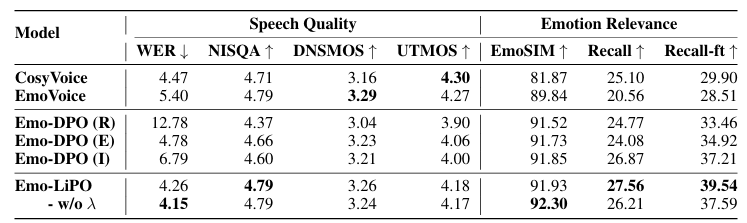
- 전체적으로 Emo-LiPO의 성능이 가장 우수함
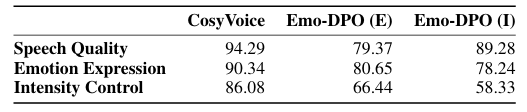
- Subjective evaluation 측면에서도 Emo-LiPO가 가장 선호됨
- Emo-LiPO는 높은 emotion recognition accuracy를 가짐

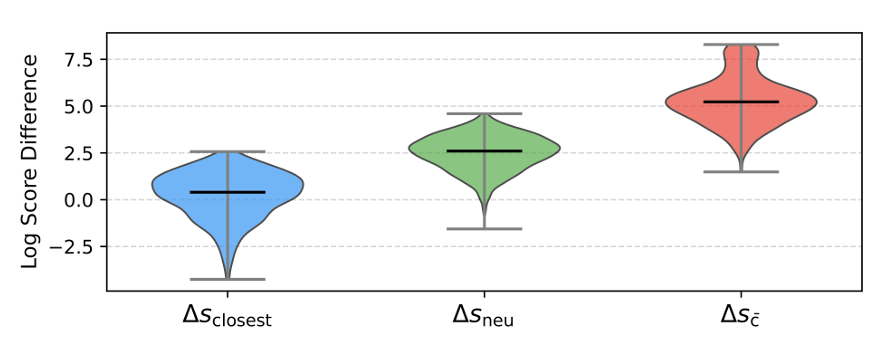
- Score Distance Visualization
- Closest same emotion sample 간의 margin $\Delta s_{closest}$, neutral sample 간의 margin $\Delta s_{neu}$, other emotion sample 간의 margin $\Delta s_{\bar{c}}$에 대해, 각 margin은 stable hierarchy를 가짐
- 즉, Emo-LiPO는 same emotion 내에서 fine-grained intensity hierarchy를 preserve 할 수 있음
- Ablation Study
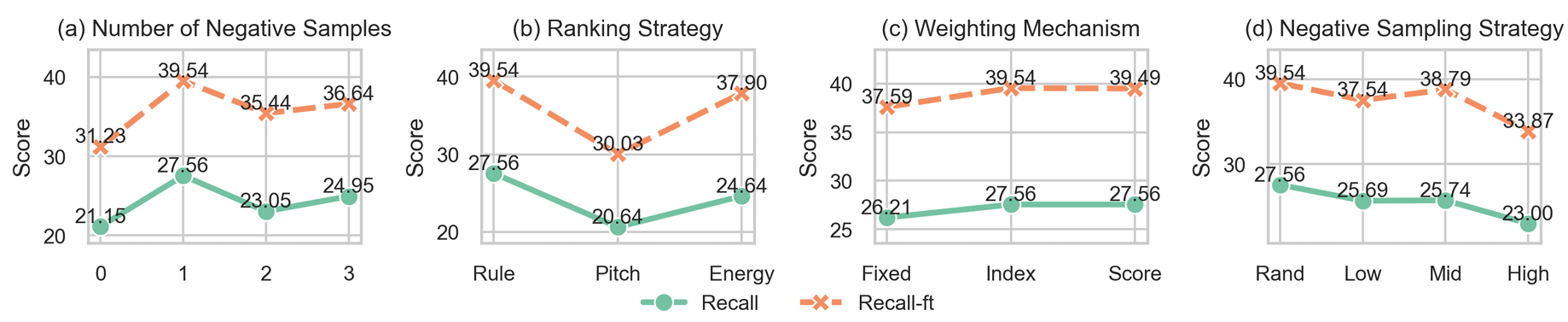
- 각 component는 성능 향상에 유효함
반응형
'Paper > Language Model' 카테고리의 다른 글
댓글